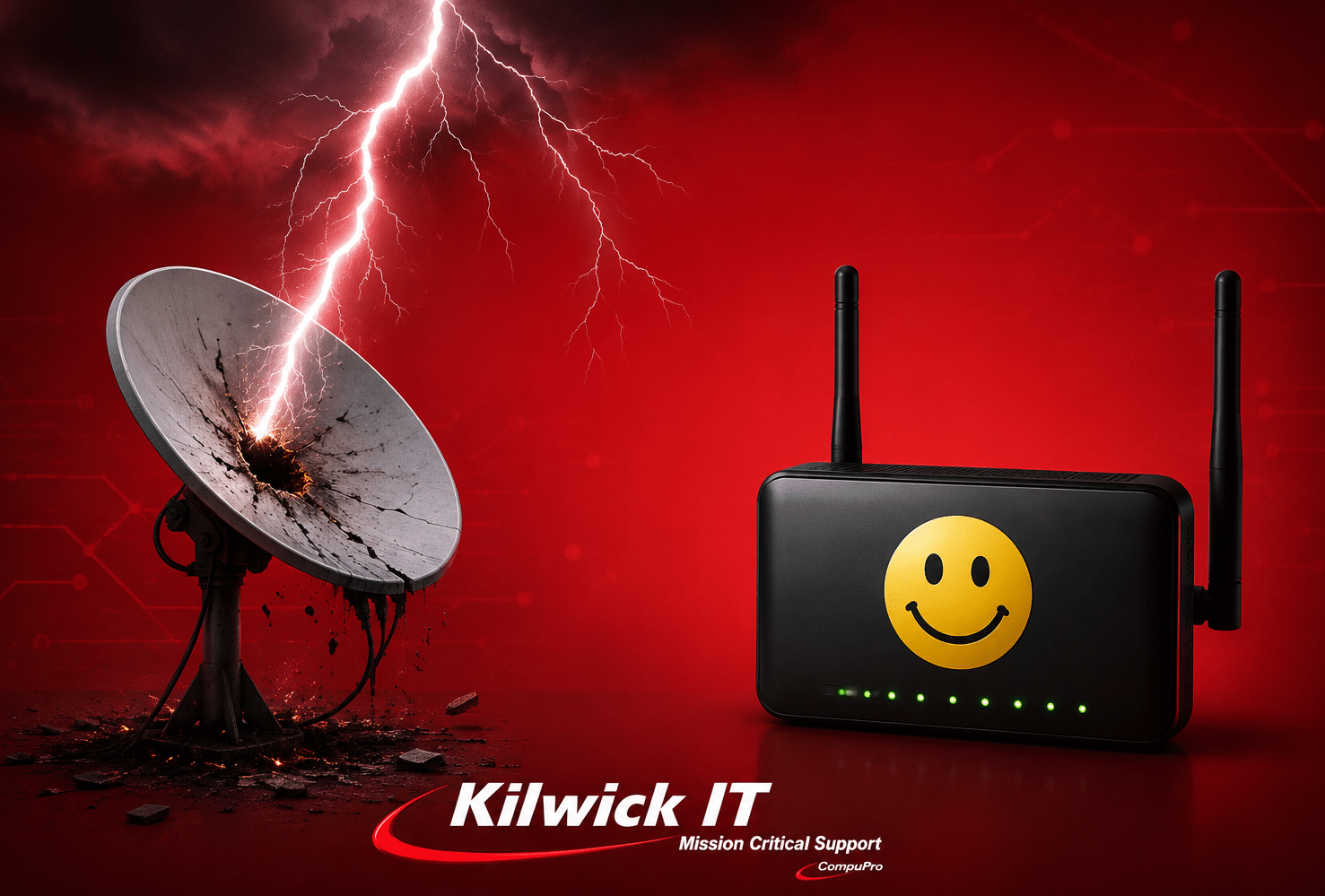
Satellite Internet: Is It Right for Your Business?
For many businesses, a reliable internet connection is no longer a convenience. It is part of the infrastructure that keeps the business operating.
Cloud applications, online bookings, email, VoIP, banking, remote access and communication with customers can all depend on having a working internet connection.
So what happens when your primary internet connection fails?
Satellite internet services such as Starlink have opened up another option for businesses, particularly those operating in areas where traditional internet infrastructure is limited or unreliable.
What is satellite internet?
Instead of receiving an internet connection through fibre, copper, terrestrial wireless or mobile networks, satellite internet uses a dish or terminal to communicate with satellites. Modern low-Earth-orbit satellite systems have made satellite internet considerably more practical for business use than earlier satellite services. This can make it particularly useful for remote offices, farms, lodges, construction sites and other locations where conventional connectivity may be difficult to obtain.
The advantages
One of the biggest advantages is availability. Where a business cannot easily obtain a reliable fibre or wireless connection, satellite internet may provide a viable alternative without waiting for terrestrial infrastructure to reach the location.
Other potential advantages include:
- Relatively quick deployment
- Useful connectivity in remote locations
- Good speeds for many everyday business applications
- Useful as a backup connection
- Can provide connectivity where traditional services are unreliable or unavailable
For some businesses, this can make a significant difference.
But satellite internet isn’t perfect
Satellite connectivity also has limitations that businesses should consider before making it their primary connection.
A satellite terminal needs a suitable location with a sufficiently clear view of the sky. Buildings, trees and other obstructions can affect the connection. Latency can also be higher than a good fibre connection. While this may not be noticeable when browsing the web or using email, it can matter for applications that are particularly sensitive to network delay. Weather and local environmental conditions can also affect performance. There are also equipment and service costs to consider, and satellite internet should be assessed against the requirements of the particular business rather than simply being viewed as a replacement for every other type of connection.
Perhaps the use: As a backup connection
For many businesses, the most interesting use of satellite internet may not be replacing their existing connection at all. It could be used as a backup. Imagine a business with a primary fibre or wireless connection. If that connection fails, a suitably configured backup satellite connection could allow essential services to continue operating while the primary connection is repaired.
That could mean continuing to access:
- Online booking systems
- Cloud applications
- VoIP services
- Online banking
- Remote support
- Customer communication
The objective isn’t necessarily to keep everything running exactly as normal. It is to keep the business connected to the services that matter most.
The right question isn’t “How fast is it?”
When choosing business internet connectivity, speed is only one consideration.
A better question is:
“What happens to our business if this connection goes down?”
For some businesses, a single reliable connection may be sufficient. For others, particularly businesses that depend heavily on cloud services and online systems, having two independent forms of connectivity may make much more sense. This could mean fibre plus wireless, fibre plus mobile, wireless plus satellite, or another combination appropriate to the location and business requirements.
Connectivity should be part of your business planning
Internet connectivity should be considered alongside other essential business infrastructure.
A business continuity plan should identify which systems depend on the internet, how long the business can operate without them and what alternative connectivity is available if the primary service fails. Satellite internet is not automatically the answer. But for the right business, in the right location, it can be an extremely useful part of a connectivity and business continuity strategy.
Need to review your business connectivity?
Kilwick IT can help you look beyond simply choosing an internet package and consider how your connectivity supports your business, what happens when it fails, and whether a backup connection would be worthwhile.
Kilwick IT
Mission Critical Support
info@kilwickit.com